
Kotak Mahindra Bank was the biggest loser from the Sensex pack, skidding 1.83 per cent, followed by Axis Bank, NTPC, Hindustan Unilever, ICICI Bank, Bharti Airtel, Reliance Industries, HCL Technologies, IndusInd Bank and Nestle. In contrast, Bajaj Finance, Bajaj Finserv, Tech Mahindra, Tata Consultancy Services, Titan, Infosys, HDFC Bank, HDFC and ITC were the gainers.


The domestic stock market may face volatility amid the monthly derivatives expiry scheduled this week, while investors would mainly await the outcome of RBI's interest rate decision on Friday, said analysts. Global market movement would also continue to drive sentiment amid a bearish trend recently following rate hikes by the US Federal Reserve and other central banks. The Reserve Bank of India (RBI) may take cues from its global counterparts to raise interest rate for the fourth time in a row to control inflation.

The Indian economy recovered from the Covid-induced downturn during 2022 and is poised for further improvement in the coming quarters though downside risks emanating from geopolitical tensions, strengthening dollar and elevated inflation will continue. The positive trajectory in the growth trend and improved fundamentals will help the nation in neutralising the impact of global headwinds which are expected to have a bearing on the country's exports in the months to come. The challenges before the government and the Reserve Bank in the new year would be to arrest inflation, check declining value of rupee against US dollar and promote private investment and growth, with a view to ensure that the country remains one the fastest growing major economies of the world.

India's exposure to Greece being limited fuelled the rally.

Kerala-based Federal Bank on Monday said it was in race to acquire ailing Ganesh Bank of Kurundwad in Maharashtra and has submitted its expression of interest to the Reserve Bank of India.

Wall Street-correlated stock markets are facing the risk of correction, as Christopher Wood, the global head of equity strategy at Jefferies, conveys to investors in his latest edition of GREED & fear. Rising crude oil prices, which are nearing $100 a barrel (Brent), pose a threat to the global central bank's battle against inflation and have led to a re-evaluation of its exposure to Indian stocks. "The potential for more US Federal Reserve (Fed) rate hikes, combined with the risk that monetary tightening finally bites as regards the economy, remains a risk for Wall Street-correlated world stock markets. "There is also the oil factor. This is why GREED & fear continues to believe the pain trade is down. "Areas in Asia, such as Indian midcaps, which have already done very well, are at obvious risk of some profit-taking," writes Wood.

Gains in realty, teck, IT, power, consumer durables, banking and oil & gas stocks helped both the key indices to score gains.
India, China and Russia have "squandered" capital by financing inefficient technologies, United States Federal Reserve Chairman Allan Greenspan has charged.

'With China falling out of favour, India is where investors see the demographic and digital dividend apart from the benefits of reforms playing out.' 'Your prime minister has also done a great job of sharing this story with the world.'

Index heavyweight RIL surged 3% to end above Rs 1,000 mark while IT majors were also the top gainers.

One of the lawyers of the chief minister said that they will be seeking urgent listing of the petition on Monday.
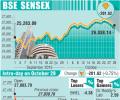
The Sensex closed 202 points lower to end at 26,838.

Jaismine Lamboria registered a dominant victory over Ana Marija Milisic of Switzerland to enter the 57kg quarter-finals of the World Olympic Boxing Qualifier in Bangkok.

As part of his preparations for the second major of the season, the French Open, world number three Roger Federer will play in next week's Madrid Open, confirmed the tournament officials.

The external environment has worsened further. While the Finnish economy entered into a recession, Swedish economic growth also dipped. The Finnish gross domestic product (GDP) dropped 0.6 per cent in October-December, 2022. It was the second quarter of negative growth, which is a technical definition of recession.

The rupee depreciated by 37 paise to close at 79.62 against the US dollar on Thursday despite sustained foreign capital inflows and a positive trend in equities. At the interbank foreign exchange market, the local currency opened at 79.22 and saw an intra-day high of 79.22 and a low of 79.94 against the American currency. It finally ended at 79.62, down 37 paise over its previous close of 79.25.
Investor wealth on Thursday soared by Rs 1 lakh crore, triggered by heavy buying in the stock market, with the BSE benchmark Sensex surging about 382 points to close at near six-week high levels.

Equity benchmarks fell sharply on Thursday in line with an extremely weak trend in the global markets, with the Sensex plunging 1,154.78 points in early trade. Persistent foreign fund outflows and a spurt in crude oil prices also dampened sentiment. The 30-share BSE benchmark was trading 1,154.78 points lower at 53,053.75. The broader NSE Nifty tumbled 335.65 points to 15,904.65.

Investors globally pulled out more than $3 billion from equity funds focused on Emerging markets including India in a week amid concerns over the US Federal Reserve's plan of curtailing its stimulus drive starting later this year.

The high court of Jharkhand on Friday granted bail to former chief minister Hemant Soren in a money laundering case linked to a land scam.
Hero MotoCorp was the top gainer in the Sensex pack, spurting 4.46 per cent. IndusInd Bank, Tata Motors, Vedanta, SBI, M&M, Sun Pharma, Tata Steel, HDFC and HDFC Bank too rose up to 3.63 per cent.

Benchmark indices continued their downtrend for the fifth session on the trot on Thursday, with the Sensex tumbling nearly 817 points in early trade, tracking weak global trends and selling in index majors Reliance Industries and HDFC Bank. Unabated selling by foreign institutional investors also weighed on the sentiment. The 30-share BSE Sensex was trading 816.78 points lower at 53,271.61. The NSE Nifty declined 234.05 points to 15,933.05.

NITI is trying to partner with other knowledge institutions.
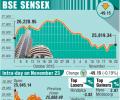
The broader markets outperformed the benchmark indices.

The 30-share Sensex ended up 390 points at 26,637 and the 50-share Nifty closed 118 points higher at 7,961.

'Unlike in the sporting arena, where sports federations moved from partisan to impartial referees, in Indian democracy's biggest festival, it appears we are moving backward from unbiased and objective to one-sided and partisan,' observes Nilanjan Mukhopadhyay.
Yes Bank was the biggest gainer in the Sensex pack, rallying 10.94 per cent. Other gainers included Sun Pharma, IndusInd Bank, L&T, ICICI Bank, Maruti, Bajaj Auto, Tata Motors and ONGC, rallying up to 4.01 per cent.

Indian equity markets had a good run in the first half of calendar year 2023 (CY23), with the S&P BSE Sensex and the National Stock Exchange Nifty50 hitting fresh 52-week highs. While the Sensex scaled up to a peak 64,718, the Nifty50 hit Mt 19,189. As the markets now prepare to enter the second half (H2) of CY23, all eyes are on global central banks, especially the US Federal Reserve, as to when they will pause and pivot as regards their interest-rate cycle.

The new Samvat 2080 is viewed as a year of hope for industrial and precious metals. A key reason is the expectation of US interest rates peaking, followed by a reduction in the coming months. Regarding crude oil, its trajectory depends more on how the situation unfolds in West Asia.
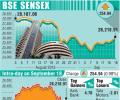
The 30-share Sensex ended up 255 points at 26,219.

Investors' wealth has eroded by over Rs 680,441 crore in three days of market fall amid weak global trends and muted domestic sentiments. Extending its losses for the third straight day, BSE benchmark Sensex on Thursday finished below the 60,000-level, weighed by hectic selling in IT, energy and finance stocks amid a sell-off in European equities. The index has lost 1,844.29 points in three sessions.

The 30-share Sensex ended at 25,706 down 151 points.

Within three trading sessions in May, foreign portfolio investors (FPIs) have pumped in Rs 9,461 crore into Indian equities. This follows net inflows worth Rs 7,936 crore in March, and Rs 11,631 crore in April. The trend, analysts said, could continue going ahead as the US Federal Reserve may soon halt its interest rate hike cycle, which will strengthen foreign fund inflows into emerging markets, including India.

'Currently, 81 per cent of all reserved tickets are booked through e-ticketing.'

Indices across Indian equity markets have edged towards new record highs before undergoing a small correction in the past few sessions. The National Stock Exchange Nifty has gained 20 per cent in the past year; mid-caps (up 33 per cent), small-caps (up 31 per cent), and micro-caps (up 44 per cent) have done better. Several factors have precipitated this rally.

ICICI Bank, HUL, HDFC Bank, M&M, Ultra Cement, IndusInd Bank and Tech Mahindra were among the losers in the Sensex pack. NSE Nifty slipped 13.95 points to 17,355.30.

Benchmark Sensex declined 224 points on Wednesday, snapping its four-session winning streak, mainly due to sell-off in IT and pharma counters amid rising concerns over possible aggressive interest rate hikes to tame high inflation. The 30-share index rebounded more than 1,200 points from the early lows before settling at 60,346.97 points, a total loss of 224.11 points or 0.37 per cent compared to Tuesday's closing level. The broader NSE Nifty closed lower 66.30 points or 0.37 per cent at 18,003.75 points.
